
Capability Checks
Part of Changing agencies
Separating a performance problem from a poor brief
Compare the brief, delivered work, client inputs and outcome measure before deciding what to correct in an agency engagement.
Before attributing weak results to an agency, compare the assignment it accepted with its delivery, the inputs your business supplied and what the result measure counts. A brief gap and a delivery gap can coexist. Decide what to correct before continuing or changing provider.
Reconstruct the assignment
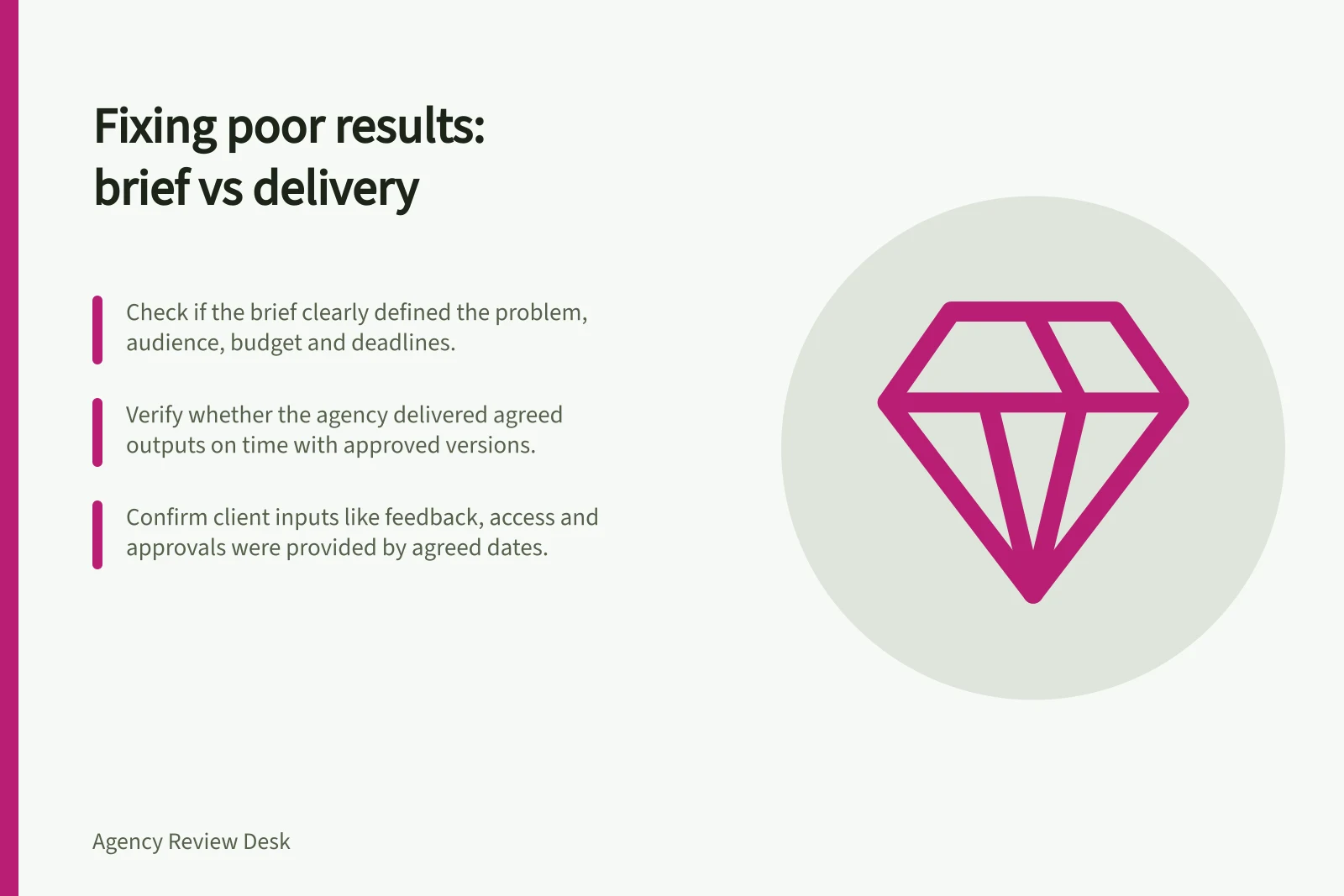
Put the approved brief, scope and later changes on one timeline. What problem did the brief describe? Which outputs did the agency accept?
What audience, offer, budget and deadlines applied? Who had to provide facts, access and approvals? Mark conditions that changed after work began.
Keep four questions separate:
Question / Evidence to inspect
- Was the request clear enough?
- The stated problem, expected output, constraints and decision owner.
- Was the agreed work delivered?
- Versions, dates, approvals and applicable acceptance criteria.
- Did the client supply its inputs?
- Access, information, feedback and decisions against agreed dates.
- Did the desired outcome occur?
- A defined business measure, period and relevant context.
An outcome can disappoint even when the agency completed the agreed work. An unclear brief also does not erase a commitment the agency accepted. Record each finding on its own evidence.
Key Questions to Assess Agency Performance
- Was the request clear enough?
- Check stated problem, expected output, constraints and decision owner
- Was the agreed work delivered?
- Review versions, dates, approvals and acceptance criteria
- Did the client supply its inputs?
- Verify access, information, feedback and decisions against agreed dates
- Did the desired outcome occur?
- Assess defined business measure, period and context
Check plausible explanations
In a hypothetical lead campaign, submitted forms rise while sales rejects many enquiries. Check whether the brief defined a useful enquiry, whether targeting followed that definition, whether forms reached sales and whether sales used a consistent qualification rule. Check changes to the offer, website and sales process too. The example is a way to investigate, not a finding about a real campaign.
Ask whether the agency flagged a material ambiguity when it became apparent and what response it received. Examine delayed client approvals or missing information that may have constrained delivery. Do not infer either party’s fault from a result chart alone.
The private agreement governs the parties’ obligations.
Choose a remedy that fits
If the brief missed the real objective, revise the problem and define a diagnostic or new scope. If an agreed deliverable was missed, identify the requirement and version, request correction and set a recheck.
If client inputs caused delay, assign them and revise the timetable. If delivery was sound but the outcome remains uncertain, decide what evidence is needed before changing provider or spending more.
Record the conclusion as a brief gap, delivery gap, client dependency, measurement gap or unresolved, with more than one label where necessary. Give any incoming agency the evidence and limits so it can investigate without inheriting an unsupported explanation.
Common Gap Types in Agency Engagements
- Brief Gap
- Unclear or misaligned problem definition
- Delivery Gap
- Missed or incomplete deliverables
- Client Dependency
- Delayed inputs or approvals from client side
- Measurement Gap
- Misaligned or undefined success metrics
- Unresolved
- Insufficient evidence to assign responsibility


