
Agency Onboarding
Part of Agency quality assurance
Reviewing a content deliverable against the brief
Check an agency content draft for reader fit, required information, factual support and final-version approval.
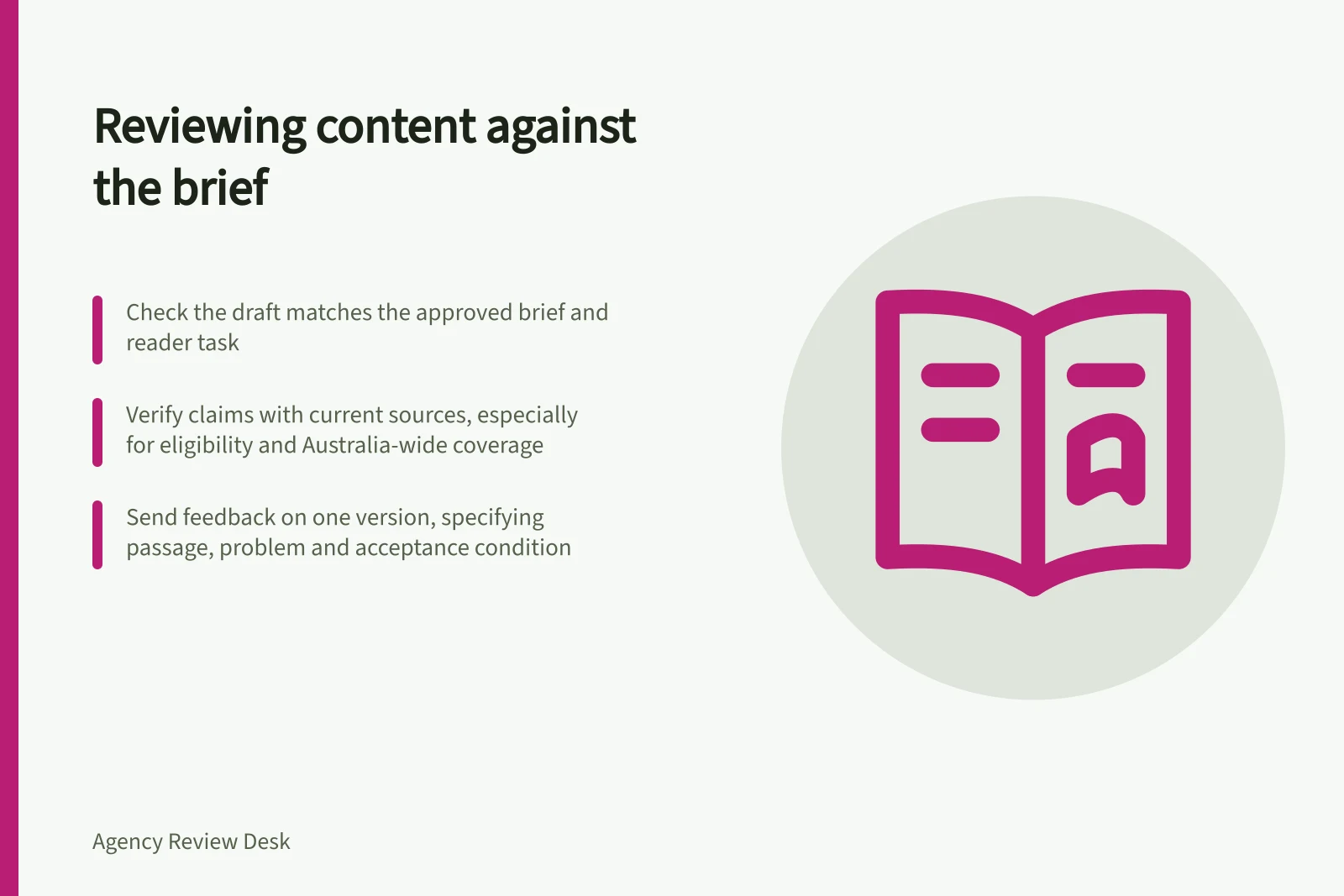
Put the approved brief beside the exact content version submitted for approval. Check that it answers the intended reader’s question and contains the agreed information.
Verify consequential claims, edit the language and compare the publishable version with the approved copy. Tell the agency which changes are required and which are preferences.
Establish what was agreed
Find the brief the agency worked from, including approved changes. Identify the reader task, required information, exclusions, format, destination and approvers.
Do not judge the draft against an expectation that was never shared. Resolve an ambiguous requirement before calling the draft defective.
Record the delivered file or preview version. If the content will appear on a page, review that placement when available: surrounding offers, headings, buttons and narrow screens may change how the copy reads.
If the page is not assembled, leave the page-context check open.
Check the answer before polishing sentences
Read the opening without consulting the brief. Can the intended reader understand what the page offers and find the promised answer?
Then scan the headings for missing information, detours and repetition. Tie required changes to the brief or the reader task.
| Brief requirement | Draft evidence or gap | Requested action |
|---|---|---|
| Reader question | Opening and relevant section | Keep, explain or revise |
| Required fact or qualification | Exact claim and supporting material | Verify, correct or remove |
| Intended next action | Copy or page component | Confirm with its owner |
A draft can meet a requirement in a form different from the one you expected. Assess whether it serves the agreed purpose before requesting a rewrite based on preference.
Verify claims and permissions
Mark consequential numbers, comparisons, dates, eligibility conditions and customer promises. Ask for a current source or a business owner who can confirm each one.
Keep a qualification beside the claim it limits. The ACCC can require businesses to back up claims they make about their products or services.
For example, if a draft says a service is available “Australia-wide” but an approved service list covers fewer locations, ask the business owner to confirm coverage and correct the sentence.
Check the permissions needed for customer names, quotations, images and third-party material in the proposed use. If permission is unknown, hold that element for its owner to resolve.
Possession of a file does not establish permission to publish it.
Claim Verification: ACCC Compliance Essentials
- Consequential claims to verify
- Numbers, dates, comparisons, eligibility
- Required source for claims
- Business owner or current documentation
- Coverage claims (e.g., Australia-wide)
- Must match service list; confirm with owner
Close the review on a version
Once the structure and facts are settled, check Australian spelling, terminology, consistency and flow. The final proof compares material about to go live with the approved master copy.
Send feedback against one identified version. Give the passage, problem and acceptance condition for each required change; separate optional style comments.
On return, check the revision and nearby text affected by it. Record who approved which version, and whether approval covers copy alone or the rendered page.