Capability Checks
Part of Reviewing agency capabilities by service
Evaluating a content agency's editorial process
Assess a content agency's briefs, factual review, editing, approvals and final proof before choosing a team.
Ask a content agency to show how one piece moved from a reader need and source material to an approved version. The work trail should reveal who checked material claims, improved the explanation, resolved feedback and confirmed the final copy. Finished portfolio pieces rarely show those decisions.
Follow one piece
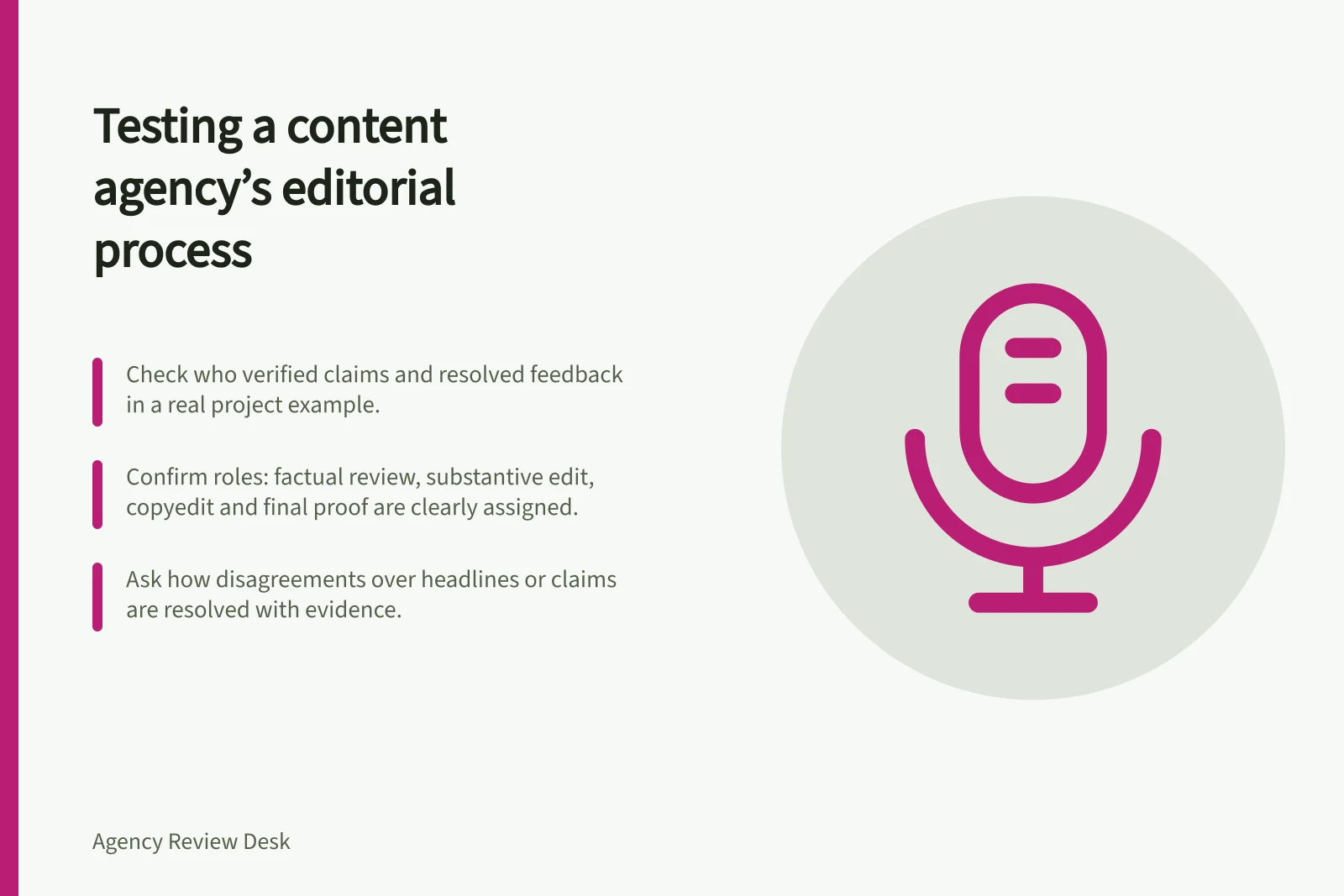
Request a redacted brief, an early draft, representative editorial comments and the approved version. Ask the proposed editor what the reader needed to understand or do, which claims required a source or subject expert, and what was removed because it was unsupported or outside scope.
If client working files cannot be shared, an anonymised example or a walkthrough of the agency's own process can still be useful. Distinguish evidence of a process used on a project from a proposed process for yours. Ask which steps depend on your staff and whether those people will be available.
Clarify who checks what
Ask how the agency separates substantive editing, copyediting, proofreading and factual review, and who is responsible for each task. Use those distinctions to ask how the agency covers the work. They are process prompts, not a required private-agency workflow.
| Task | Question for the proposed team |
|---|---|
| Brief and research | Who confirms the reader need, scope and usable source material? |
| Factual review | Who checks consequential claims, dates and qualifications, and records open questions? |
| Substantive edit | Who tests whether the structure and explanation serve the reader's task? |
| Copyedit | Who applies agreed voice, terminology and Australian English? |
| Final proof | Who compares the version about to be published with the approved copy? |
One person may perform several tasks. What matters is that the agency can show when each check happens and who resolves an issue. If your organisation must approve legal, technical or product claims, agree what it must receive and when.
Key editorial checks in Australian content standards
- Australian English compliance
- Required for all government and public sector content (Source: https://www.stylemanual.gov.au/writing-and-designing-content/editing-and-proofreading)
- Factual accuracy verification
- Mandatory for claims about benefits, dates and qualifications
- Reader need alignment
- Must be confirmed before drafting begins
Test a disagreement
Consider a stronger headline requested by a marketing lead that a product specialist says overstates the offer. Ask who can amend the claim, who checks the revised wording and which version becomes authoritative. The answer reveals whether feedback becomes a verified change or an unresolved instruction.
Ask what evidence the agency would use to understand your audience. A keyword list alone does not establish those needs. If evidence is thin, the agency should be able to identify the assumption and propose a proportionate way to check it.
Choose a process your reviewers can support. Record what the sample demonstrated, what remains a promise and which client approvals could delay a piece. This is a decision about the proposed editorial system; inspection of a delivered article against its brief comes later.
Using sample content to assess editorial quality
- Pros
- Demonstrates real-world decision-making, evidence use and conflict resolution
- Cons
- May rely on hypothetical or anonymised examples if actual files aren’t shared