
Capability Checks
Reviewing agency capabilities by service
Assess an agency's technical SEO, paid media, content and design capability using evidence suited to each service.
Review an agency against the work it would actually perform in each service you need. Ask for an example showing how the proposed team diagnosed a problem, made a decision, produced an output and checked or handed over the work. A service list alone cannot answer those questions.
Match evidence to the service
Start with the services in the proposed engagement and the job each must do. “SEO” might mean diagnosing an indexing problem or advising on site structure. “Design” might mean exploring a concept or preparing an interface for development. Ask where the agency’s responsibility begins and ends, and what your team must supply.
| Service | Evidence to request | What to examine |
|---|---|---|
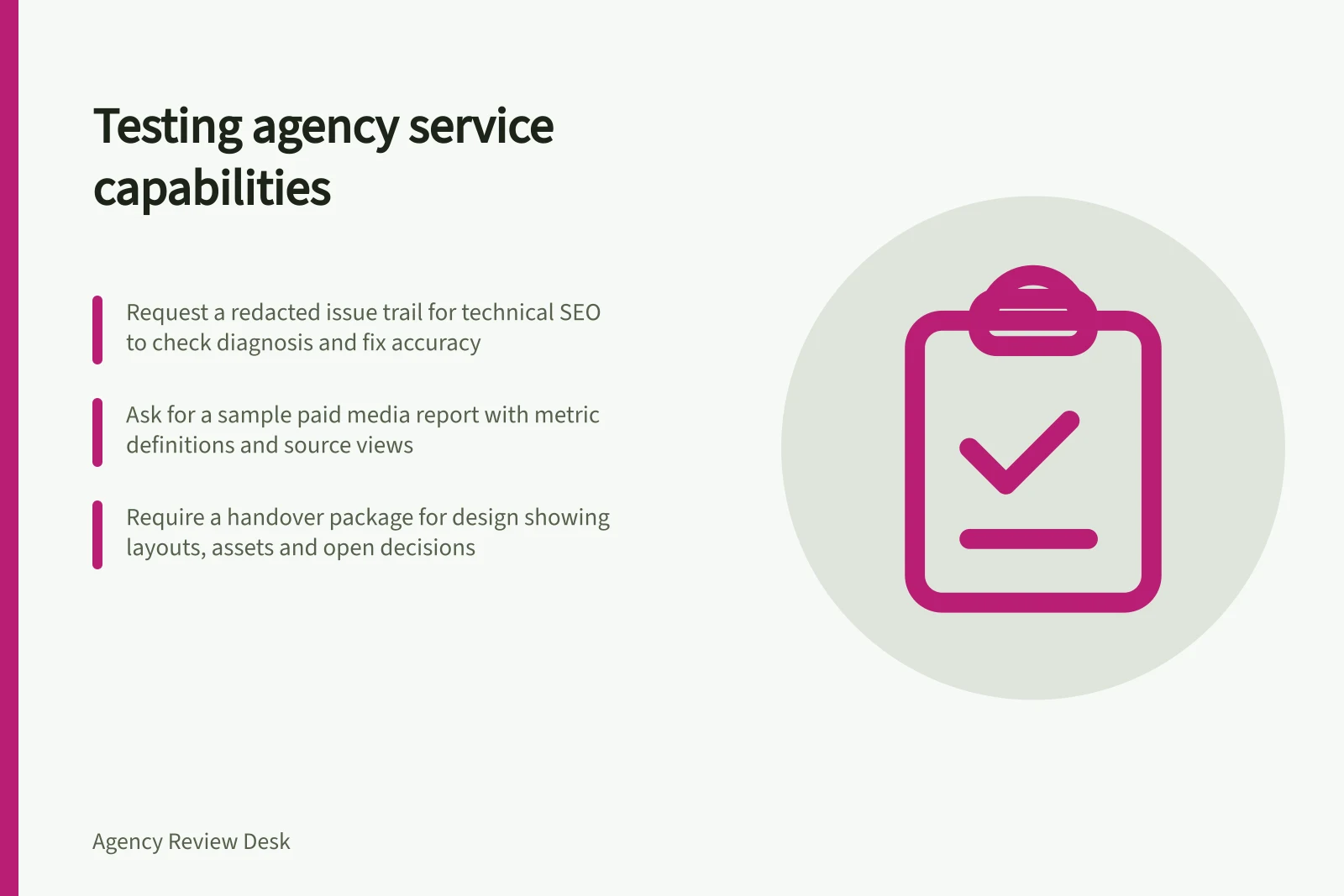
| Technical SEO | A redacted issue trail with affected URLs, diagnosis, recommended fix and follow-up | Whether the explanation connects the evidence to a practical change |
| Paid media | A sample report with metric definitions, source views and account changes | Whether a client can trace a conclusion to what was measured and done |
| Content | A brief, edited draft and approval trail with confidential details removed | How research, factual review, editing and approval shaped the final piece |
| Design | A representative handover with layouts, states, assets and open decisions | Whether the next team could build or use the work without guessing |
Confidentiality may limit what a candidate can share. An anonymised walkthrough can still show its method, provided you record which details remain unverified.
Test operational capability across the work
For technical SEO, ask the specialist to show how they establish whether a page can be crawled and indexed. Google’s stated minimum technical requirements include allowing Googlebot access, returning an HTTP 200 status and providing indexable content in a supported file type that does not violate spam policies. A walkthrough can show whether the team checks each condition rather than assuming a page is eligible.
Ask how the team investigates URLs that are missing from search results. Google recommends using both the Page Indexing report and Crawl Stats report in Search Console because they may contain different information; its URL Inspection tool can test an individual page and check its status code. Evidence of this process can help distinguish a diagnosed access or response problem from an unsupported claim about the cause.
For accessibility work, look beyond a designer’s individual decisions and check whether the proposed team can carry implementation through. W3C recommends developing accessibility skills across the people involved, including designers, developers, content creators and managers. Ask which roles in the proposed work will need that expertise and how the team makes sure it is available during delivery.
W3C also recommends documenting and sharing experience gathered during implementation, including approaches that did not work as well as successful ones. Ask for an example of how the team recorded a lesson and passed it to relevant people, so the same avoidable problem is less likely to recur in later work.
Check whether accessibility is built into the relevant working processes rather than left to a final review. W3C gives web content publishing workflows as an example of where accessibility checks can be incorporated, and recommends integrating accessibility goals into organisational procedures and policies. Where your staff or another supplier will publish or build the work, clarify who carries out those checks and how the result is handed over.
Ask the specialist to explain a choice
Choose one consequential decision in the example. Ask what the team knew at the start, which explanations or options it considered, who made the decision and what it checked afterwards. Separate an observed problem from a proposed cause and from a result that has yet to be measured.
The limits differ by service. Google says that meeting its minimum technical requirements makes a page eligible to be indexed by Google Search. A technical SEO example should not turn a fix into a ranking promise. For a Google Ads example, ask what conversion action underlies a slide labelled “leads”.
For content, ask who handles factual review, substantive editing, copyediting and the final proof. For digital design, ask how accessibility decisions reach developers and how the built work will be checked. A static screen does not establish accessibility of the finished service.
Resolve boundaries between services
When services depend on one another, name the person who coordinates them. A content plan may require site changes; a paid campaign may depend on a landing page and measurement setup. Ask who specifies the related work, who performs it and who checks the combined result. If another supplier or your staff must act, give that dependency an owner.
For each required service, record shown, partly shown or still unknown, with the example or unanswered question behind the label. Request clarification on an essential unknown before deciding whether the proposed team can perform this assignment.
In this guide
- Assessing an agency's technical SEO evidenceCheck an agency's technical SEO issue trail, diagnosis and handover without treating indexing or ranking as guaranteed.
- Reviewing a paid media agency's reporting transparencyInspect a paid media agency's sample report for conversion definitions, account changes, cost records and uncertainty.
- Evaluating a content agency's editorial processAssess a content agency's briefs, factual review, editing, approvals and final proof before choosing a team.
- Checking a design agency's handover standardsReview a design agency's sample handover for screen states, assets, accessibility decisions and implementation questions.