Agency Onboarding
Agency reporting and accountability
Set up agency reporting that connects delivered work, audience response and business outcomes with clear sources, caveats and decisions.
An agency report should answer three questions: what was done, what changed and what decision follows. Settle those questions before choosing charts. Completed tasks can confirm delivery, but they cannot by themselves show whether the work served the agreed outcome.
Start with the agreement
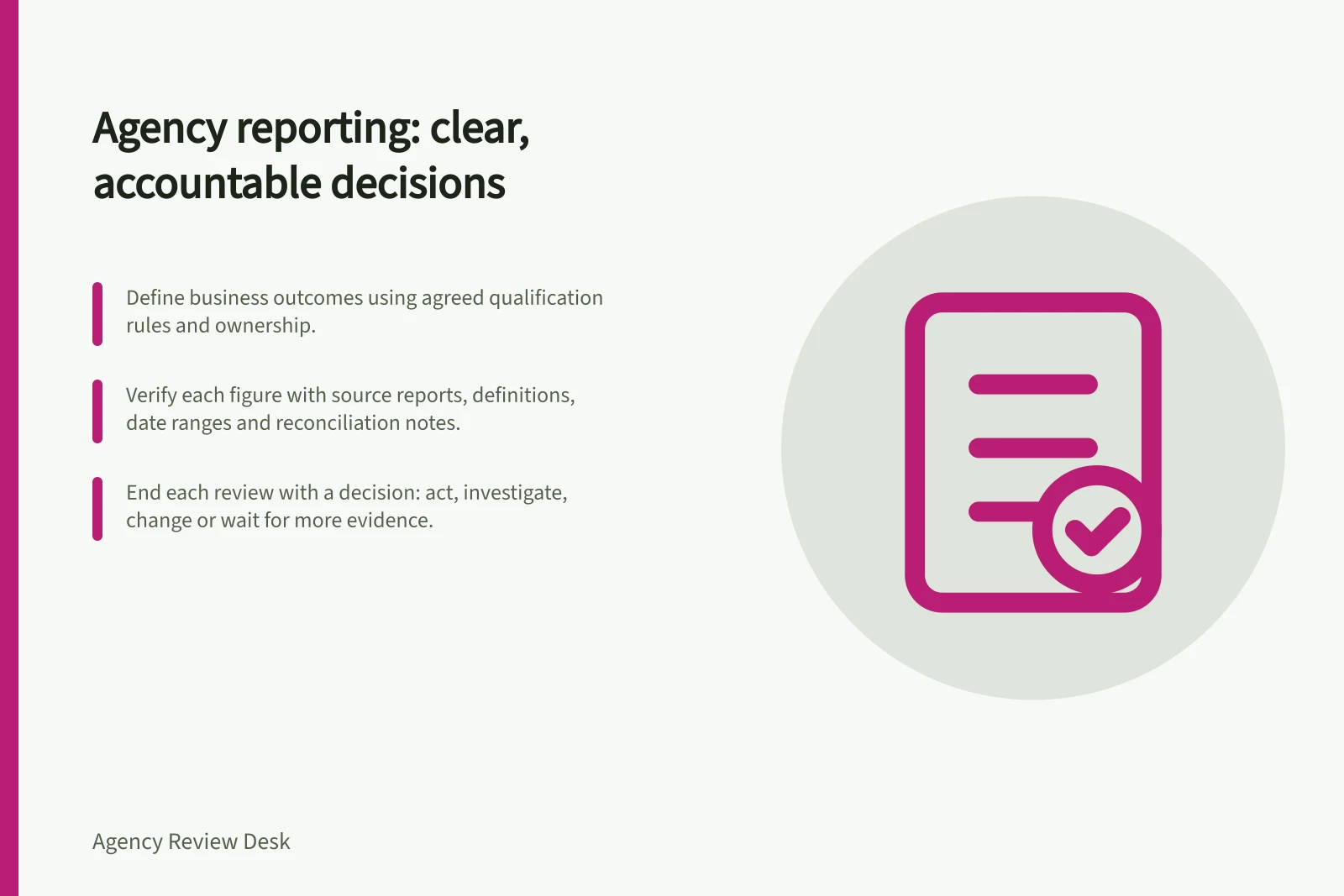
Draw the outcome from the brief or current work plan and express it in terms the business recognises. For a lead generation assignment, that might mean enquiries meeting agreed qualification rules. For a website project, it might mean completion of a specified customer task. Name the owner of the business record, the reporting period and the starting point for comparison.
Give each measure a job. Delivery measures show whether the agency did the work. Response measures show what people did.
Business measures show the result the organisation values. Record each definition beside its number: the dates and accounts covered, relevant exclusions, and whether the figure is observed, estimated or awaiting confirmation.
| Review question | Evidence to request | Decision it supports |
|---|---|---|
| Was the agreed work delivered? | Completed items against the work plan, with dates and approval status | Accept, correct or reprioritise work |
| Did the intended audience respond? | Relevant channel or site measures, with definitions | Continue, change or investigate an approach |
| Did the business outcome move? | The appropriate business record, with known gaps | Act, investigate or wait for more evidence |
This is a reporting chain, not proof that the agency caused every change in the business result. A reporting method may organise observed results, but it does not establish what would have happened without the work.
Make the numbers inspectable
For each headline figure, ask for the source report or export, metric definition, date range, filters, account and extraction date. If a figure comes from a sales system, record who supplied it and how enquiries were matched to outcomes. If two systems cannot be reconciled, show the difference and explain it.
For platform-reported figures, check the relevant documentation for how the data is defined and any reporting limitations. Put relevant qualifications beside the result and agree when to review it again.
A recorded form submission can be a useful signal. It does not establish that the enquiry was qualified, won or profitable. If the business cannot provide an outcome record, say what the report shows and what remains unknown.
Key Reporting Principles
- Source verificationRequest source report or export, metric definition, date range, filters, account and extraction date
- Platform data validationCheck documentation for data definitions and reporting limitations
- Data reconciliationIf two systems don’t match, show the difference and explain it
- Outcome clarityA form submission signals interest but does not confirm qualification, win or profitability
End each review with a decision
Ask the agency to explain material movements: what changed, what supports its explanation, what else could explain the movement and what it proposes next. Include client actions or constraints when they affect interpretation. Record the decision, its owner and the date for checking it.
The result may be to continue, change course, investigate a discrepancy or wait for a defined result to mature. If the same question remains unanswered each month, change the report or the measurement arrangement.
In this guide
- Choosing a report that connects work to agreed outcomesChoose an agency report that traces agreed outcomes through delivered work, observed response and the next decision.
- Distinguishing agency activity from business impactSeparate delivered work, exposure, response and business outcomes so an agency report does not overstate its impact.
- Reviewing data sources behind agency performance reportsTrace agency report figures to their source, check metric definitions and reconcile differences without hiding them.
- Asking an agency to explain uncertainty rather than hide itAsk an agency to distinguish observations, interpretations and reporting limits, then agree when to act or review again.