Pricing Models
Agency contracts and scope
An agency agreement should make everyday collaboration predictable.
A clear agency contract sets out the work, fees, approval process, ownership of work and exit arrangements.
Identify the contracting parties
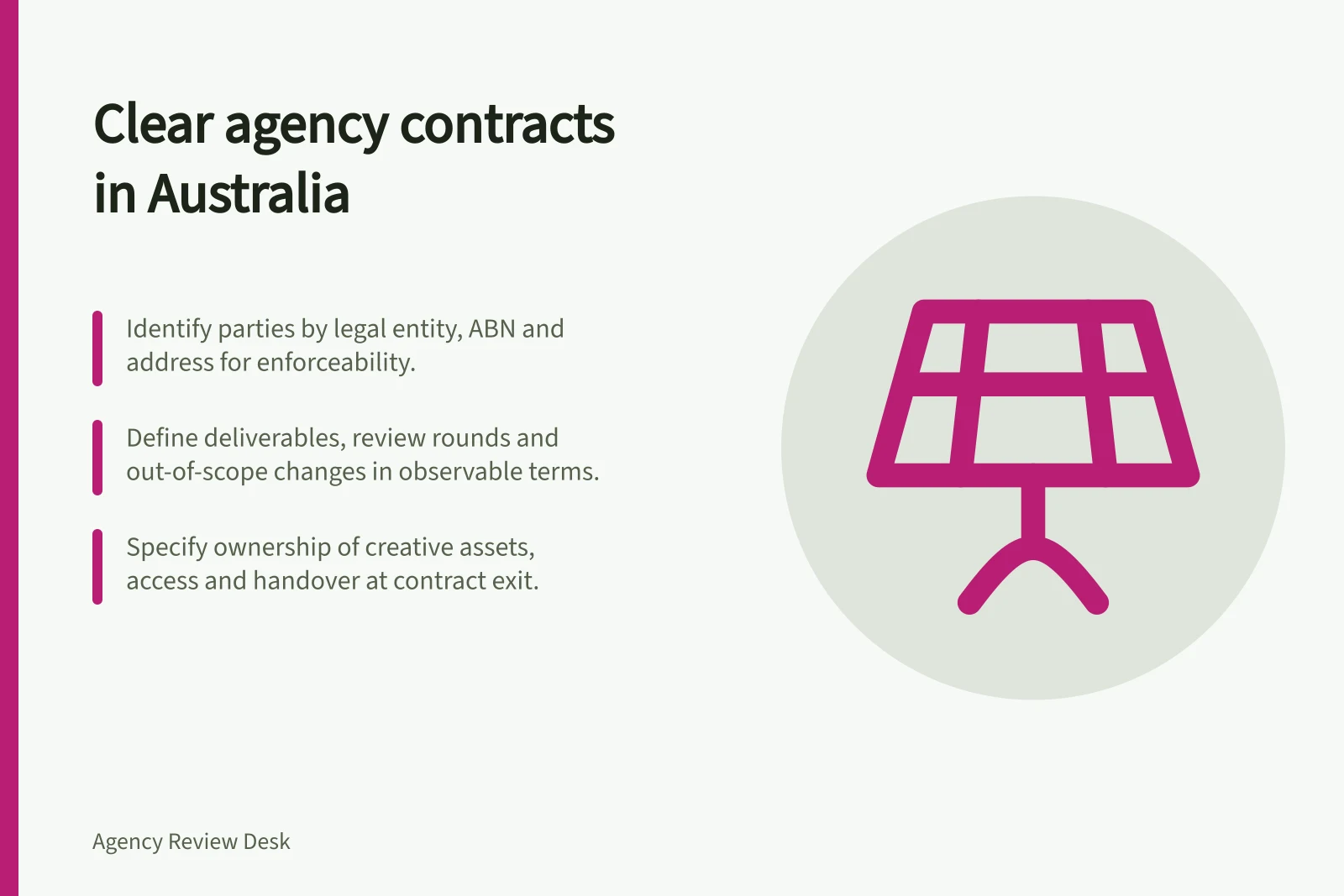
Name each party’s correct legal entity, not just a trading name. If the contract names “Design Co” but the client pays “Design Co Pty Ltd”, it may be unclear who is liable and who owns the work.
Include each party’s ABN, address and primary contact. These details help direct notices and identify which state’s courts may hear a dispute, so they should match the entities actually entering the arrangement.
Describe the work in observable terms
List deliverables, channels, markets, expected cadence and the inputs each party will provide. Separate strategic advice from production and account management. State what counts as complete and how many review rounds are included, if relevant.
“Manage social media” leaves room for different interpretations. A schedule of content types, approvals, reporting and exclusions is easier to operate.
Define an out-of-scope request by its effect on deliverables, effort, timetable or risk. A new campaign, extra language or change to the underlying brief may require a written estimate and approval before work begins. Small clarifications can remain within scope if the agreement says how they are handled.
Keep a change log so informal messages do not quietly rewrite the fee.
How to manage scope changes without disrupting the contract
- Define what counts as complete deliverableE.g., '12 social media posts per month with approved copy and final edits'
- Set out included review roundsE.g., 'Two rounds of revisions per asset included in fee'
- Classify out-of-scope requests by impactE.g., new campaign, multilingual content, major brief change
- Require written estimate and approval before work beginsPrevents informal scope creep
- Maintain a change logDocuments all modifications to scope, cost, timeline
Make price and payment match the arrangement
The commercial terms should explain how the price is calculated and when payment is due. For a retainer, check that the monthly fee is linked to clearly defined inclusions. That lets the recurring charge be compared with the agreed work rather than an open-ended description of services.
Check that the fee structure and scope describe the same arrangement. If the written contract differs from a proposal or earlier discussions, the signed terms may not reflect what either team expects to deliver or pay for.
Plan control and exit before there is a dispute
Review notice, renewal, cancellation fees and what work is owed during a notice period.
Specify who owns existing and newly created creative, source files, data and licences, and when rights transfer. Distinguish an agency-owned tool from a client campaign account.
Record administrator access, export format, credentials and the handover help required at exit. A client who cannot reach its account or retrieve editable files may face a costly transition even when the finished artwork is delivered.
Choose a term and renewal model
A fixed-term contract has a definite start and end date for the campaign. A retainer usually continues until either party ends it, often with a notice period and a monthly fee tied to defined inclusions. The contract should make clear which arrangement the parties have chosen.
If the contract renews, state how renewal occurs and give the client clear advance notice, a genuine opportunity to opt out and a workable notice window. An automatic renewal that rolls a client into another 12 months without a reasonable chance to exit may be unfair; the circumstances of the particular term matter.
Fixed-term vs retainer contracts: key differences
- Renewal Mechanism
- Explicit renewal terms required; automatic renewal may be unfair under ACL
- Exit Flexibility
- Easier to exit at end of term; retainers require notice period
- Payment Structure
- One-off or milestone-based vs recurring monthly fee tied to inclusions
Treat the written terms as the operating record
A marketing services agreement records the services, payment, ownership of completed work and how either party can end the relationship. Once signed, it displaces promises made in emails and phone calls; the written terms are what count if things go wrong. Check that important commercial understandings are in the contract.
Understand when unfair-term protections may apply
The Australian Consumer Law’s unfair contract terms regime can apply to standard-form small-business contracts. The supplied legal guidance describes a small-business contract as one where at least one party employs fewer than 100 people or has a turnover under $10 million. Whether a term is unfair depends on the contract and circumstances; a business should not assume every automatic renewal or exit clause is invalid.
Since 9 November 2023, proposing or relying on an unfair term can attract penalties under the Australian Consumer Law. The cited guidance states that the maximum for a company can be $100 million, three times the benefit gained or 30 per cent of turnover, and the maximum for an individual can be $2.5 million. These are maximum penalties, not automatic outcomes for every disputed clause.
The ACCC helps businesses and consumers understand unfair contract term law and may investigate and take compliance or enforcement action to protect consumers and small businesses. It does not investigate individual complaints or provide legal advice.
Put approvals on a clock
The agreement should identify who can approve copy, spend, publication and scope changes. It should set out the approval process and what happens if a decision is delayed. The framework should suit the campaign’s risks and timetable.
Approval workflow process for marketing campaigns
- Who can approve?Client’s designated decision-maker(s) and agency account lead
- What happens if delayed?Work pauses until approval received; timeline extends by delay duration
In this guide
- Defining what counts as an out-of-scope request“Out of scope” is useful only when both client and agency can identify it before work starts.
- Reviewing cancellation and notice termsCancellation terms should tell both parties what happens if the work ends early.
- Agreeing who owns creative files and campaign accountsAn agency may deliver finished ads while keeping the editable source files, or manage campaigns in an account the client cannot control.
- Recording the approval process in an agency engagementApproval should connect a named person to a specific version and consequence.