Pricing Models
Part of Agency pricing and commercial models
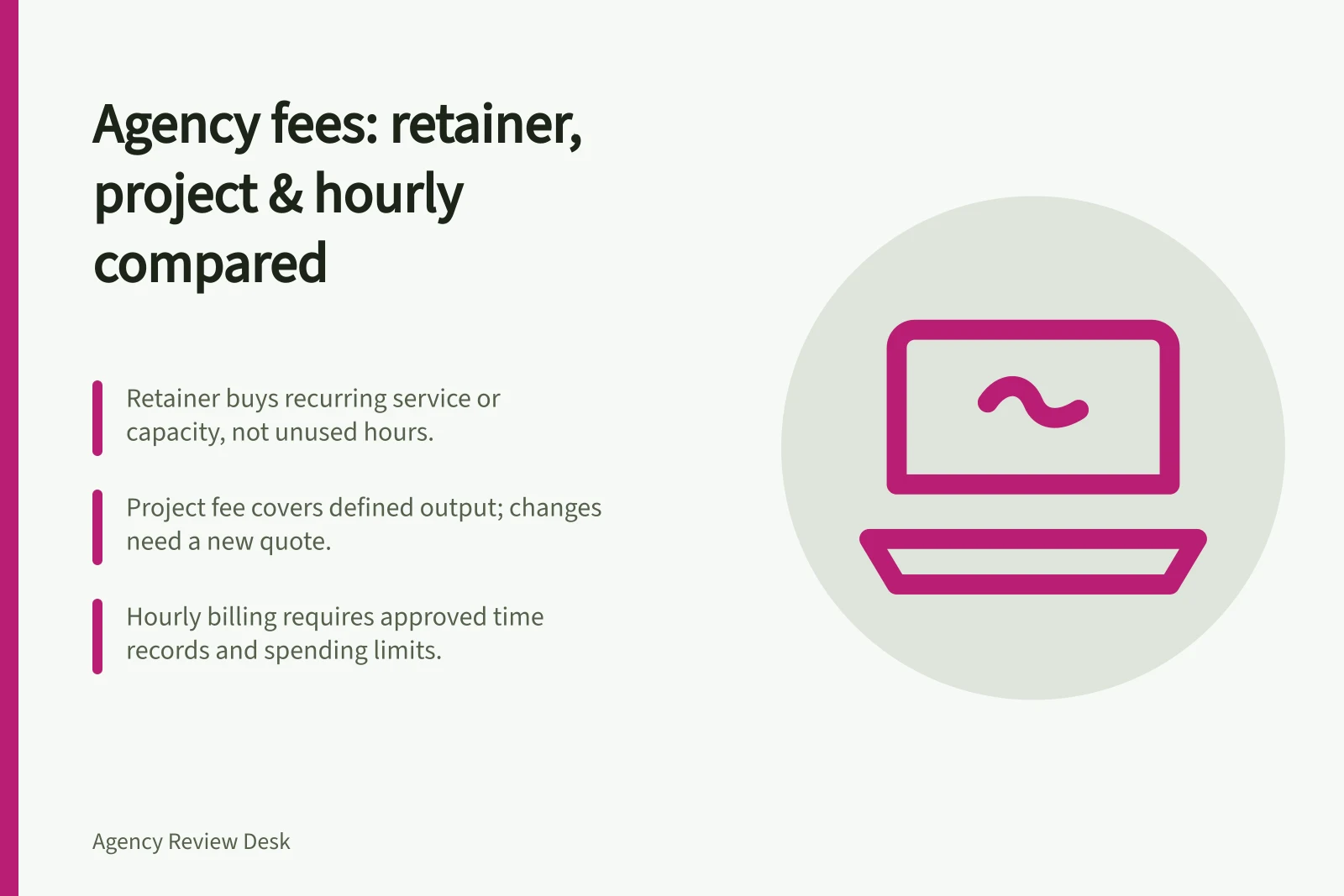
Retainer, project and hourly agency fees compared
Compare agency retainers, fixed project fees and hourly rates by the work purchased, cost triggers and controls each model needs.
Consider a retainer for defined recurring work, a project fee for a scoped output, and hourly or daily billing for a limited task with uncertain effort. Before choosing, check what each fee buys, what changes it, and how you will control the final cost.
Retainer: define the recurring commitment
A retainer might buy an agreed service, a stated amount of capacity, or both. Ask which arrangement is offered. Describe the work or decisions expected each period, its cadence, and when priorities are reviewed.
An urgent request may replace planned work, use an hours allowance, or cost extra. Confirm the treatment in the proposal.
If the fee buys hours, ask what happens to unused time. If it buys a service, do not assume an unused-hours balance exists.
Check when the fee begins, when it can be reviewed, and what happens if the required work changes.
A retainer fits best when the ongoing obligation is clear enough to manage, even if individual tasks change. Write down the first period's priorities so the monthly amount has practical meaning.
Key Considerations by Pricing Model
- Retainer: Unused hours
- Not carried forward unless specified
- Project fee: Completion point
- Clearly defined with acceptance criteria
- Hourly/daily: Approval authority
- Must be agreed in writing
Project fee: define the finished work
A fixed fee is easier to assess when the outputs, quantities, dependencies, and completion point are clear. For a website stage, a quote might specify page types, content responsibility, integrations, review rounds, and handover. If an important starting condition is unknown, consider a separately priced inspection before seeking an implementation price.
Agree what is included in the fee and what would prompt a variation. Tie payment milestones to work that can be inspected and state who accepts it. A fixed price commits the agency to the agreed job; a changed job may need a changed price.
Hourly or daily: control authorised effort
Time-based billing can suit troubleshooting or a bounded investigation when the steps are hard to predict. Request rates by role, the tasks authorised, and an estimate with its assumptions.
Agree who can approve time, how often records and updated estimates arrive, and whether work must stop at a spending limit until you approve more.
Compare likely effort as well as rates. A lower hourly rate does not establish a lower final fee if the job takes more time or needs a different mix of people.
Compare the offer, not the label
| Question | Retainer | Project fee | Hourly or daily |
|---|---|---|---|
| What is bought? | An agreed recurring service or capacity | A defined output or stage | Authorised time on a task |
| What could raise the fee? | Extra work or a revised commitment | A change to the agreed job | More time or a different role mix |
| What should you monitor? | Work plan and periodic review | Milestones and variations | Time records and spending approvals |
Ask each candidate to price the same required first stage. If an agency proposes a fixed diagnostic followed by an optional retainer, show the price and decision point for each stage separately. Confirm applicable GST, billing dates, and additional-cost approval in the written terms.
Agency Pricing Models: Retainer, Project Fee and Hourly/Daily Compared
- What is bought?
- An agreed recurring service or capacity
- What could raise the fee?
- Extra work or a revised commitment
- What should you monitor?
- Work plan and periodic review
- What is bought?
- A defined output or stage
- What could raise the fee?
- A change to the agreed job
- What should you monitor?
- Milestones and variations
- What is bought?
- Authorised time on a task
- What could raise the fee?
- More time or a different role mix
- What should you monitor?
- Time records and spending approvals
How to Compare Agency Fee Models
- Ask each agency to price the same first stageEnsure apples-to-apples comparison before deciding
- Break down fixed diagnostics from optional retainersShow separate pricing and decision points for clarity
- Confirm GST, billing dates and approval processesInclude in written terms to avoid disputes