Capability Checks
Part of Agency reviews and rating methodology
Correcting an agency profile after receiving reliable new information
How to check new evidence, update an agency profile and explain a material correction to readers.
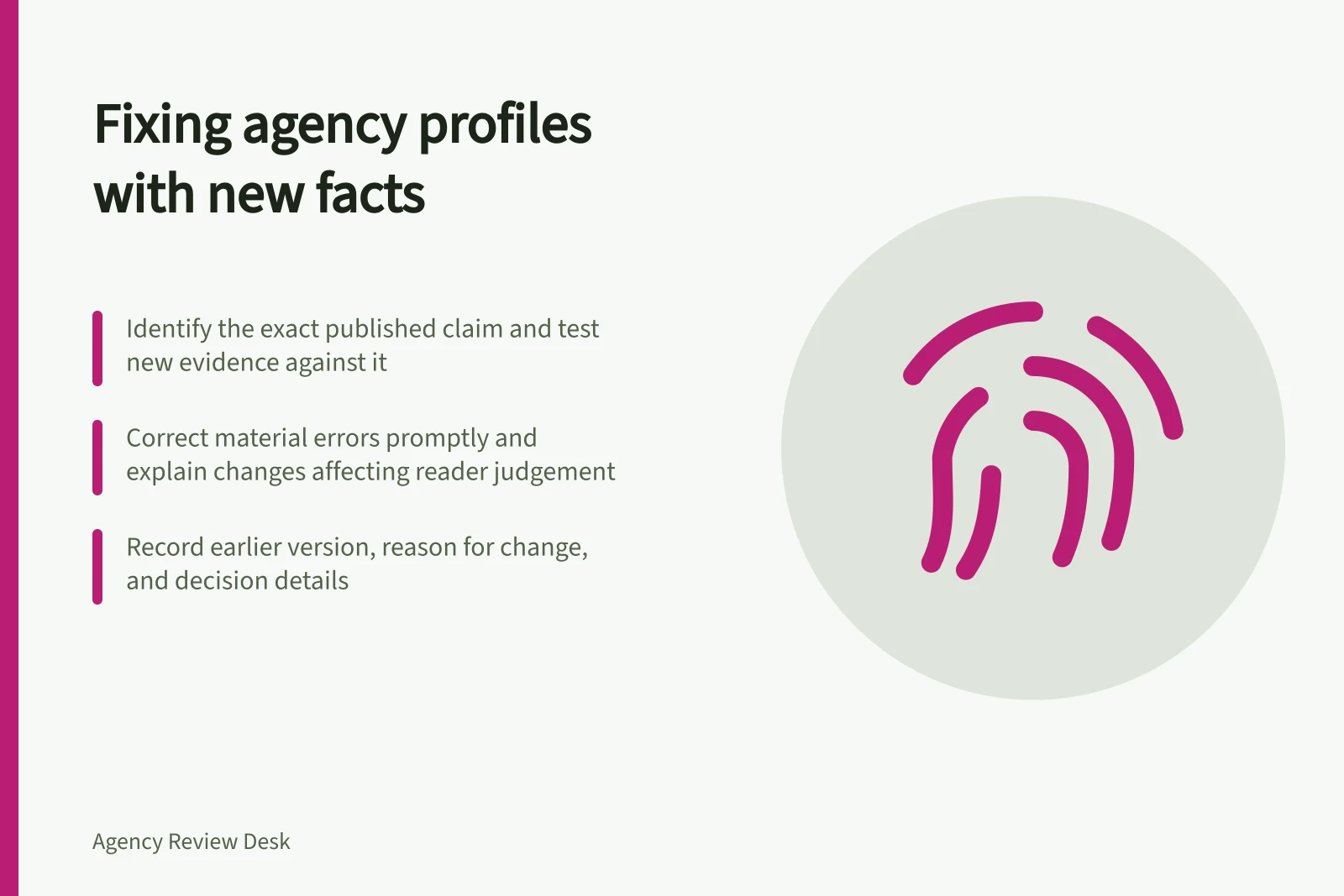
When credible new information challenges an agency profile, identify the exact published claim and test the new evidence against it. Correct a material error promptly and explain any change that affects the reader's judgement. Record the earlier version and the reason for the decision.
Compare the report with what was published
Record the profile, passage, report date and material supplied. Check the wording and qualification readers saw at the time. A service change today does not necessarily make an accurately dated earlier statement wrong. An incorrect account of who performed a project may have been wrong from the start.
| Finding | Response to consider |
|---|---|
| Clear factual error | Correct it and decide whether readers need a visible note |
| Accurate when published, now outdated | Update the current fact and show the update date |
| Credible but unresolved challenge | Investigate and qualify or hold the affected claim where warranted |
| Disagreement with an assessment | Revisit the criterion and evidence; revise the judgement if its basis changes |
The significance of the claim determines how visible the remedy should be. The table is a decision aid, not an automatic rule.
Verify the new information
Ask what source can establish the new fact. An agency statement may establish what it currently offers. A disputed project result may require its definition, dates and the agency's role.
Seek other relevant accounts when a material claim depends on them, and record what could not be checked. A complaint alone is not proof.
Keep a copy or version record of the existing page while investigating. If a prominent claim cannot currently be supported and risks misleading readers, withdraw or qualify it and record why. Avoid silently replacing one uncertain statement with another.
Make the public remedy complete
Correct the profile and any summary or comparison that repeats the error. Add a dated note explaining a change that materially affects how readers would understand the agency. A spelling fix may need no prominent notice; a changed rating, service scope or claimed result calls for a clearer explanation and a review of related judgements.
Place the new qualification beside the affected claim. A correction note cannot fix a headline or score that still gives the wrong impression. Record the previous wording, new evidence, decision, editor and publication time. Check the revised page and reused excerpts after the change.
Australian Press Council principles call for a correction or other adequate remedy when material within the Council's jurisdiction is significantly inaccurate or misleading. They are an editorial reference here; this site's jurisdiction has not been established. The ACCC's separate advice about false customer reviews addresses a different format and should not be treated as a correction rule for editor-authored profiles.
Tell the person who reported the issue what was decided and, where useful, what remains unverified. A decision to retain the original wording should rest on the evidence, not on whether the report was favourable to the publisher.
Key Regulatory Guidelines for Profile Corrections in Australia
- Australian Press Council Principle
- Correction or adequate remedy required for materially inaccurate or misleading content
- ACCC Guidance on False Claims
- Applies to customer reviews; not a rule for editor-authored profiles
- ACCC on Online Reviews
- Addresses false or misleading claims in user-generated content