Proposal Comparison
Part of Agency reviews and rating methodology
Explaining why an agency comparison may not fit every buyer
Check an agency comparison's intended buyer, service scope, inclusion rules and evidence before using its results.
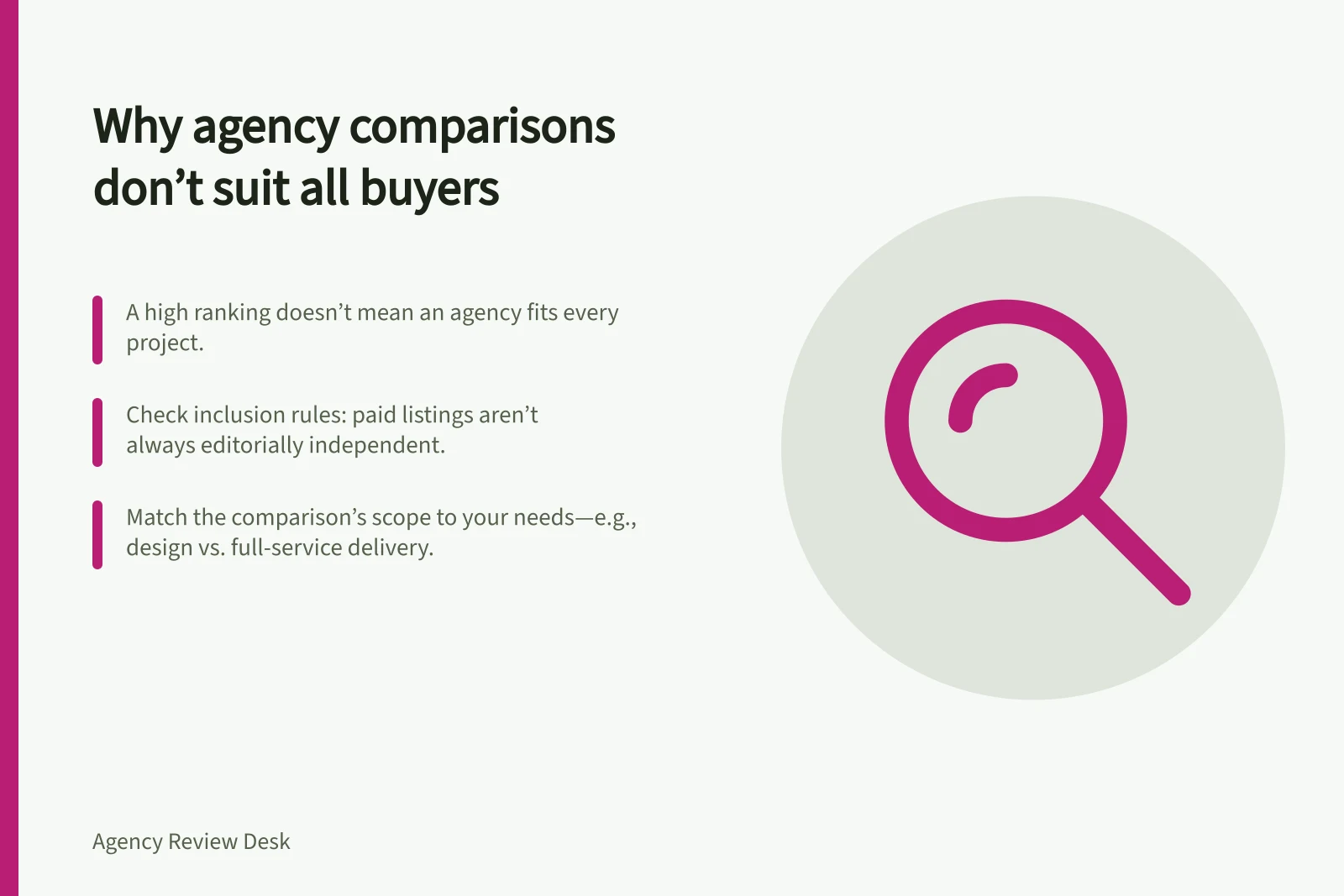
Use an agency comparison only for the decision its scope and evidence can support. Before you rely on its order or rating, check the work it covers, how agencies entered the set, when they were assessed and what remains unknown. A high placement does not establish that an agency suits every project.
Identify the intended buyer
Look for the problem the comparison was built around. Website design, ongoing paid media management and a mix of services require different evidence. So do buyers with an internal implementation team and those seeking an agency to deliver the whole job.
A business replacing a complex website, for example, might use a design-focused comparison to find candidates. Published designs give limited evidence about migration, integrations or the team available for that work unless those matters were examined. A buyer seeking a short diagnostic project would need to ask different questions.
Read the inclusion rule before the ranking
Check whether the publisher invited candidates, required enough information to assess them or accepted paid listings. A comparison can be useful with a limited set provided its title and summary do not imply a complete market survey. Check what a paid position means before treating it as an editorial recommendation.
Then examine whether the entries rely on comparable evidence. A detailed case study and a public service description support different conclusions. Missing evidence is a gap in the comparison, not a finding that an agency performs poorly.
If your decision depends on… / Check whether the comparison examined…
- A specialist task
- Work in that discipline and the proposed team's role
- Connected services
- Coordination and handovers between disciplines
- A fixed deadline
- Current capacity and dependencies
- An unusual constraint
- How the agency handled a comparable constraint
- A bounded budget
- The scope behind any cost description
Use the result as a shortlist input
Take the gaps into conversations with candidates. Ask who would perform your work, what would be delivered, what your team must supply and which assumptions affect the proposal. A profile may accurately describe past work while leaving these current questions unanswered.
The ACCC says it can require businesses to back up claims about their products or services. For publications within its jurisdiction, the Australian Press Council's principles call for factual material to be accurate and not misleading, and distinguishable from opinion. Neither point makes every editorial agency list an advertisement, but they support checking the basis and qualifications of strong claims.
A comparison fits best when its assessed work and included agencies are close enough to your decision to help form a shortlist. When a critical requirement lies outside its scope, use it to discover candidates and investigate that requirement separately.
Pros and Cons of Relying on Agency Comparisons
- ProsHelps identify potential candidates; useful for forming a shortlist when scope aligns with your needs
- ConsMay omit critical details like team availability, project constraints, or assumptions behind cost estimates
Regulatory Standards for Agency Claims in Australia
- ACCC Requirement
- Businesses must substantiate claims about products or services
- Australian Press Council Principle
- Factual content must be accurate, not misleading, and distinguishable from opinion