Agency Briefs
Part of Agency reviews and rating methodology
Publishing an agency review with a disclosed evidence base
A process for recording agency-review claims, checking their support and disclosing what a published review examined.
Before publishing an agency review, separate supported facts, agency-supplied claims and editorial judgement. Tell readers what was examined, when it was examined and what remains unverified. A review assembled from public material must not imply that its writer interviewed customers or tested the service.
Record the claims
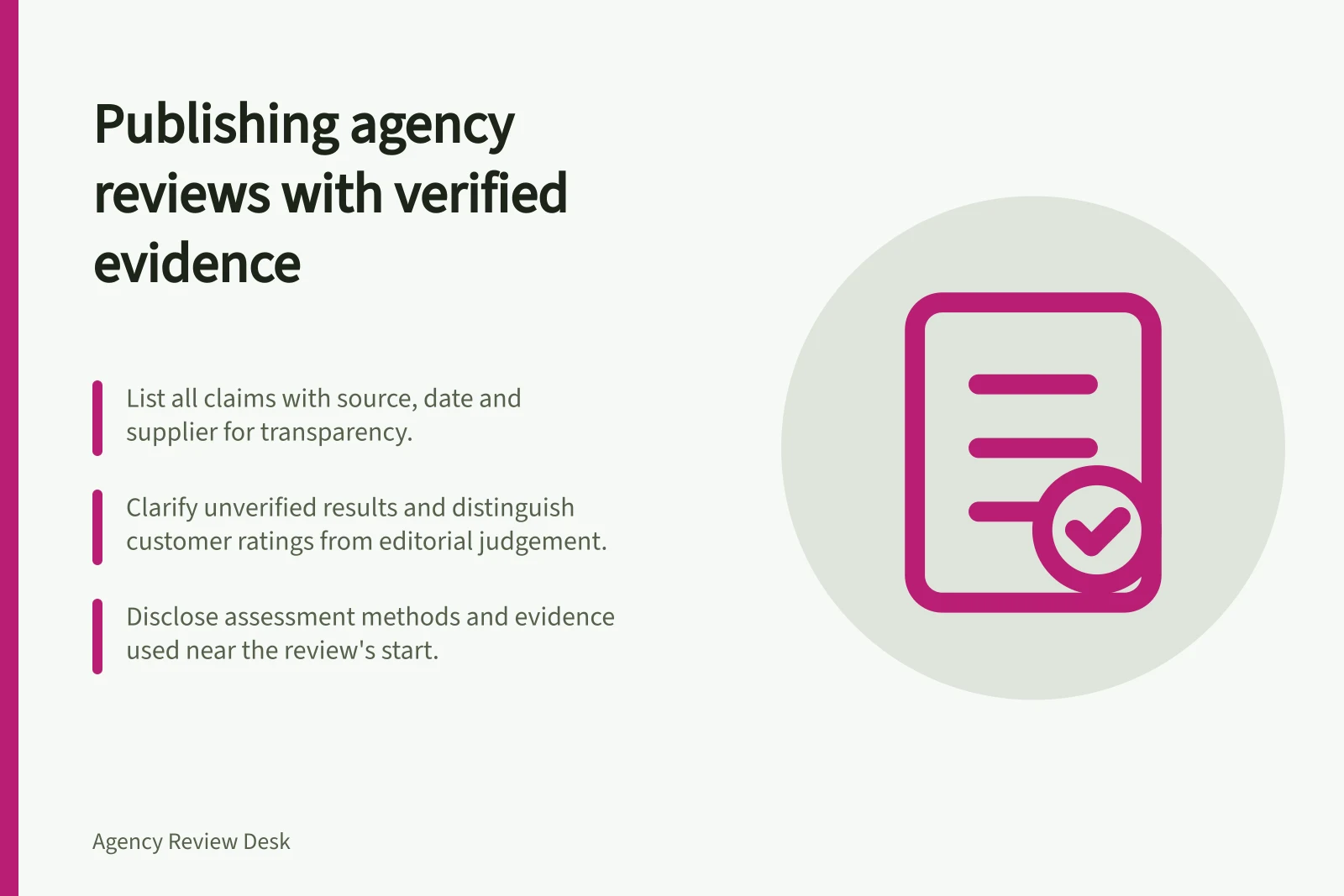
List the material statements the profile may make: services, markets served, relevant work, proposed people, reported results and commercial terms. For each, record the source, date, supplier and precise claim it supports.
An agency website can show what the agency says it offers; it cannot independently establish delivery quality. An agency case study may describe a project without establishing that the agency caused every reported result.
Type of statement / What the review needs
- Factual description
- A current record supporting the exact wording
- Reported result
- Its definition, period, source and the agency's role
- Editorial judgement
- A stated criterion and the observations behind it
- Unknown
- An explicit gap rather than an inferred answer
Keep customer ratings distinct from the editor's assessment. If a star rating is shown, explain its source and, where available, the number of customer reviews and any relevant incentive or commercial relationship.
What Each Statement Type Requires in an Agency Review
- Factual Description
- A current record supporting the exact wording
- Reported Result
- Definition, period, source and agency’s role must be specified
- Editorial Judgement
- Stated criterion and observations behind the conclusion
- Unknown
- Explicit gap—no inference allowed
Clarify material points
Give the agency specific factual questions and an opportunity to correct information about its operations. Ask for supporting material when an answer would change an important claim.
Record the reply and identify what, if anything, was independently checked. An inability to share confidential client data may leave a reported result unverified; it does not establish that the result is false.
An agency can point out factual errors without controlling the conclusion. Where accounts differ, explain the evidence and either narrow the statement or leave it unresolved. Do not present a disputed interpretation as a settled fact.
Key Principles from Australian Regulatory Guidelines
- ACC C Compliance
- Avoid implying testing or interviews if only public data used
- Online Review Integrity
- Case studies do not prove causation; agency role must be clarified
- Media Standards
- Disputed interpretations must not be presented as settled facts
Disclose the basis on the page
Near the opening or summary, name the service and market covered, assessment date and kinds of material used. State whether there was a purchase, customer interview or live test.
Attribute important claims to an agency statement, customer account or other record as appropriate. Place a material limit beside the judgement it qualifies.
Before release, compare the final copy with the claim record. Check names, dates, outcomes and qualifiers.
Narrow or remove a prominent claim if its evidence does not support the wording. Keep the record and published version so a later challenge can be assessed against what readers saw.
This disclosure helps a reader decide which questions to ask an agency next. It does not turn incomplete public information into proof of how that agency would perform on a new project.