Agency Briefs
Part of Choosing a digital agency in Australia
Defining the work before searching for an agency
Define the problem, outcome, constraints and internal contribution before looking for a digital agency.
Before you search, describe the problem, the decision you need help with and the limits an agency would work within. Leave the method open. You can then search for the expertise the job needs, not an attractive list of services.
Write the problem in business terms
Start with an observation and its consequence. “Our product pages receive enquiries that the sales team cannot qualify” is more useful than “we need SEO”. It gives a prospective partner a problem to investigate without assuming search traffic is the cause or the solution.
Note what you know and what remains a hypothesis. If your team suspects the website, say why: customer feedback, a change in the enquiry mix or a known technical fault. Do not turn an untested suspicion into a requirement. Name the person who can confirm the underlying business facts.
State the desired outcome in terms your organisation recognises. It might be more suitable enquiries, a usable website journey or a clearer way to assess campaign performance. Record the current baseline if you have one, and say plainly when you do not. A target invented solely to make the note look complete will make later judgement harder.
Essential elements of a strong agency brief
- Problem clarity
- Use observable business issues, not assumed solutions
- Outcome focus
- Define success in organisational terms (e.g., better lead quality)
- Evidence-based reasoning
- Distinguish known facts from hypotheses
- Constraint transparency
- Include fixed deadlines, budgets, system limits, compliance needs
- Internal readiness
- Confirm who will support delivery — e.g., developer, sales lead
Separate necessary conditions from possible methods
List the boundaries a provider must respect: launch date, available budget, systems, markets, approval roles, accessibility needs and any claims your business cannot make. Keep preferred tactics separate so candidates can challenge them.
A compact working note can use five prompts:
Prompt / What to record
- Problem
- What is happening, and why does it matter?
- Outcome
- What would a useful change look like?
- Evidence
- What observations support the problem, and what is uncertain?
- Constraints
- Which dates, systems, approvals or resources cannot move?
- Internal contribution
- Who can supply information, make decisions and implement changes?
The note helps you identify the expertise needed and gaps that could prevent useful conversations. A later brief can add the detail a provider needs to propose or price the work.
Structured approach to defining agency work
- ProblemWhat is happening, and why does it matter?
- OutcomeWhat would a useful change look like?
- EvidenceObservations supporting the problem; what remains uncertain?
- ConstraintsFixed dates, systems, approvals, resources — non-negotiables
- Internal contributionWho can provide input, decide, or act post-delivery?
Decide what you need someone to do first
Ask whether the first purchase is diagnosis, a defined deliverable or ongoing management. If you cannot tell why results are poor, a limited investigation may be more useful than a year of channel activity.
If the cause is established and your team lacks delivery capacity, specify the output and handover you need. If work is recurring, describe the decisions and production that must happen repeatedly.
Be candid about internal capacity. An agency can recommend a change that requires your developer, sales lead or product owner to act. If that person has no time, the proposed timetable is incomplete. Identify these dependencies before using them as selection criteria.
End with a one-paragraph search statement: “We need help with [problem] for [audience or process], aiming for [outcome]. We can provide [inputs]. The work must fit [constraints]. We need a provider to recommend [first decision or output].”
The statement gives you a consistent basis for finding candidates without pretending you have already solved the problem. Revise it when evidence changes.
Key steps to define your agency work before searching
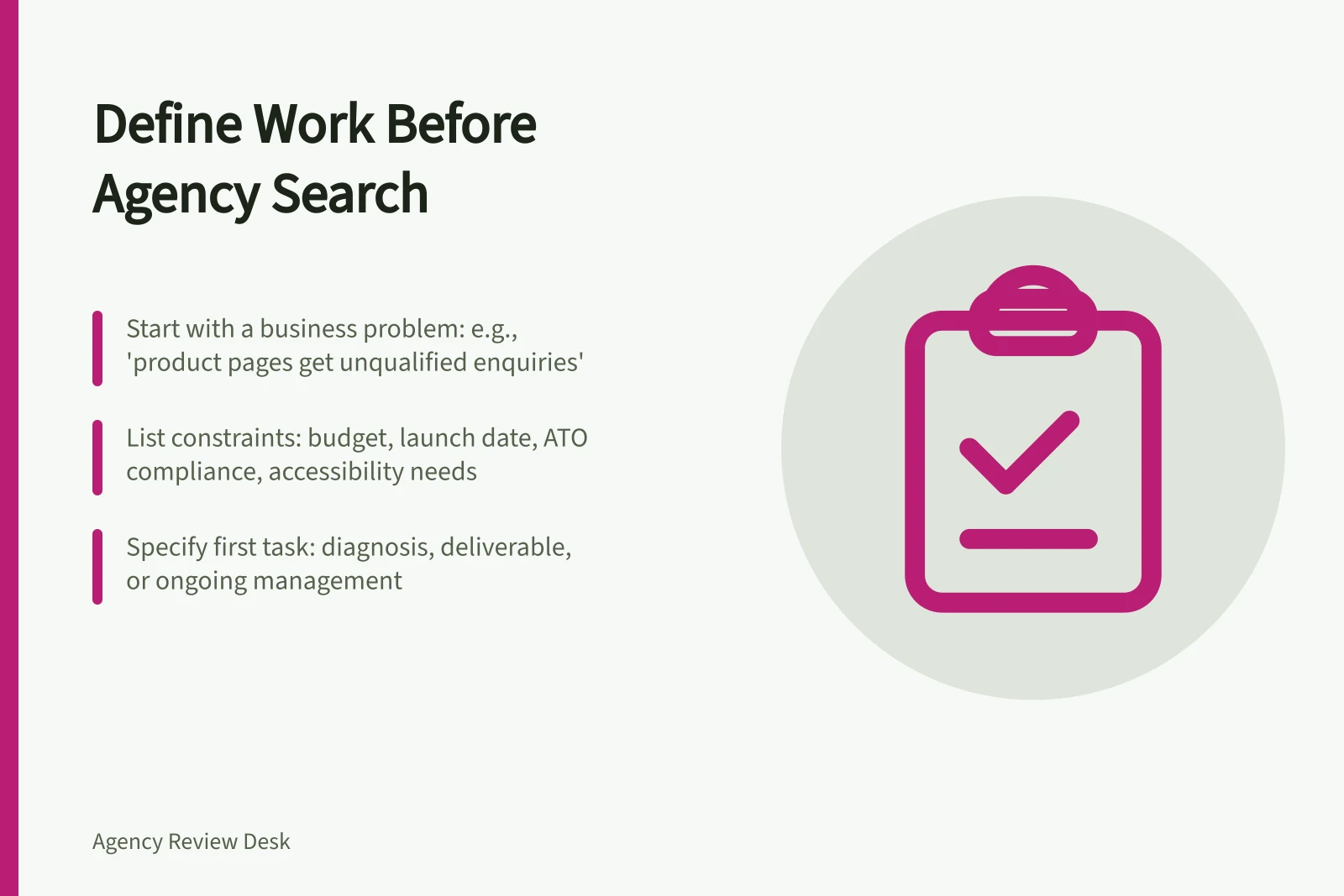
- Start with a clear business probleme.g., 'Our product pages receive enquiries that the sales team cannot qualify'
- Define the desired outcome in business termse.g., 'more suitable enquiries' or 'a clearer way to assess campaign performance'
- List necessary constraintse.g., launch date, budget, systems, accessibility needs, approval roles
- Identify internal contributorsWho can supply information, make decisions, implement changes?
- Clarify the first task: diagnosis, deliverable, or ongoing management?Avoid committing to full-scale activity without understanding root causes