Proposal Comparison
Part of Choosing a digital agency in Australia
Deciding whether to hire an agency or an independent consultant
Choose between an agency and independent consultant by checking the work, implementation capacity, continuity and accountability you need.
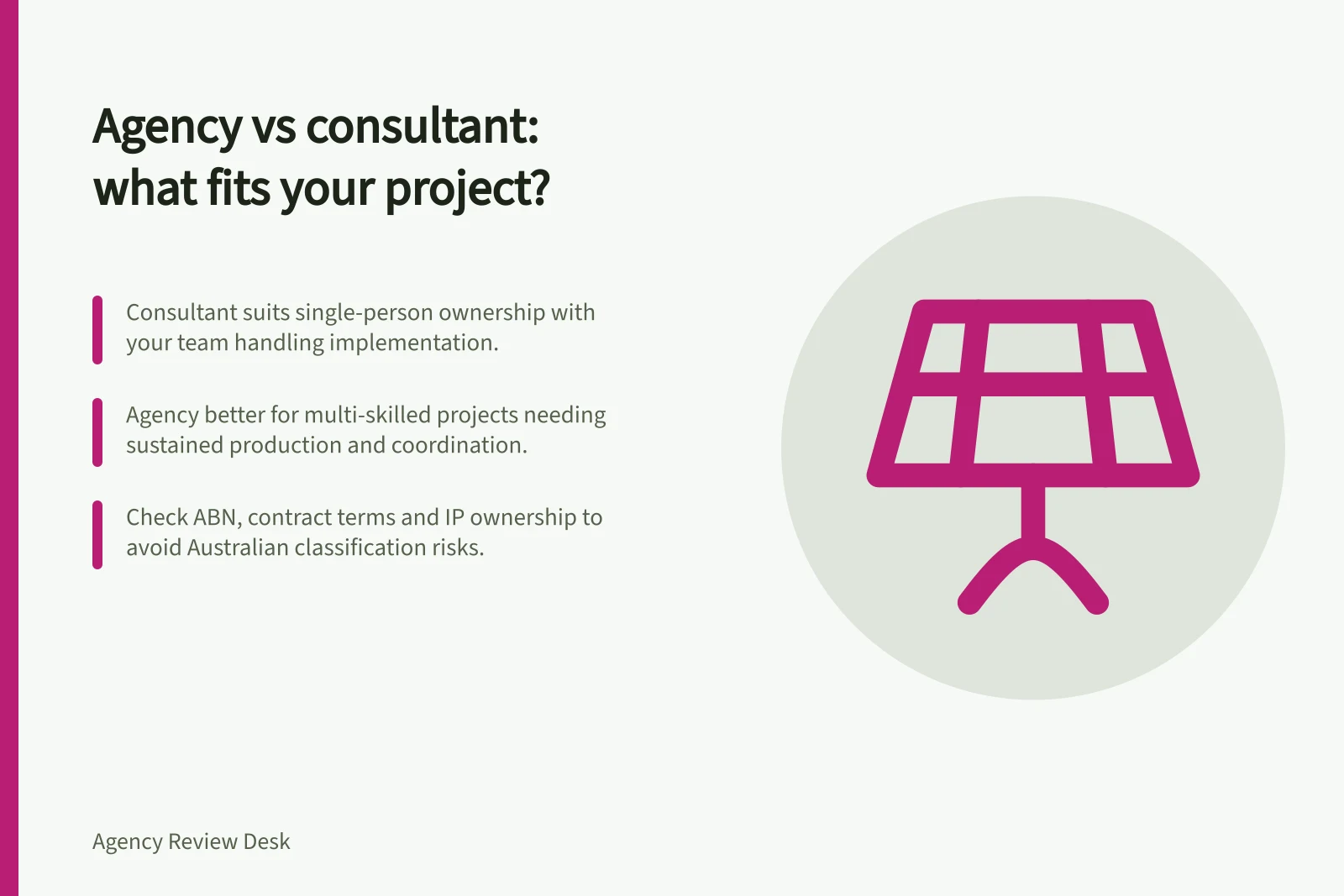
Hire an independent consultant when one person can own the job and your business can provide implementation or coordination around them. Consider an agency when delivery needs several skills, sustained production or a managed team. First decide whether you need advice, execution or both: the title “consultant” does not guarantee implementation.
Match the provider to the work
Write down the result you need and mark each step as diagnosis, recommendation, production, approval or ongoing management. A consultant could be a good fit for an audit and a set of prioritised decisions.
If the same project also needs design, development, copy, media operations and regular reporting, ask who will coordinate and perform those tasks. An agency may offer that team, but you must verify the people and capacity proposed for your account.
| Decision factor | Question to ask |
|---|---|
| Skill mix | Can one person competently do the essential work, or are several disciplines needed? |
| Implementation | Who will turn recommendations into approved changes? |
| Continuity | What happens if the named person is unavailable or leaves? |
| Coordination | Who resolves dependencies and conflicting advice? |
| Accountability | Who accepts a deliverable and corrects work that misses the agreed requirement? |
An agency is not automatically a safer choice. It can rely heavily on one account lead or use external specialists. A consultant may have a dependable network. Ask how each arrangement would operate in your project rather than assuming a structure from its name.
Agency vs Independent Consultant: Key Decision Factors
- Skill mixCan one person competently do the essential work, or are several disciplines needed?
- ImplementationWho will turn recommendations into approved changes?
- ContinuityWhat happens if the named person is unavailable or leaves?
- CoordinationWho resolves dependencies and conflicting advice?
- AccountabilityWho accepts a deliverable and corrects work that misses the agreed requirement?
Pros and Cons of Hiring an Agency vs Independent Consultant
- Agency – ProsAccess to multiple skilled professionals; coordinated team; managed project delivery; consistent oversight.
- Agency – ConsHigher cost; potential dependency on one account lead; external specialists may lack consistency; unclear accountability across disciplines.
- Independent Consultant – ProsSingle point of contact; lower cost; focused expertise; easier to manage scope and timelines.
- Independent Consultant – ConsLimited capacity; responsibility for coordination falls on your team; risk if they’re unavailable; no built-in team for execution.
Compare the complete commitment
Request a description of deliverables, the proposed people, the work excluded and the input required from your team. For advisory work, agree whether you will receive a presentation, a working plan, implementation support or follow-up review. For managed delivery, identify who approves work and who can change priorities.
Compare the total work your organisation must absorb. A consultant’s fee may cover only diagnosis, while your staff or other suppliers carry out the recommendations. An agency proposal may bundle coordination and production, or leave important tasks with you.
Neither arrangement has a universally lower total cost. Judge the quoted scope alongside the internal time and other providers needed to finish the job.
A bounded first engagement can resolve uncertainty. For example, a consultant might investigate why enquiries are rejected, while your team decides whether to implement the recommendations internally or seek a delivery team.
Alternatively, an agency could be asked to diagnose and propose a staged delivery plan. State the usable output and decision point in either case. A proposed pilot is not evidence that it succeeded.
How to Decide: A Step-by-Step Approach
- Define the desired outcomeWrite down the result you need and mark each step as diagnosis, recommendation, production, approval or ongoing management.
- Assess skill and delivery needsDetermine whether one person can deliver all required tasks or if multiple disciplines are needed.
- Clarify responsibilities and inputsRequest a clear description of deliverables, proposed people, excluded work, and your team’s required input.
- Evaluate total commitmentCompare not just fees but also internal time and additional suppliers needed to complete the job.
- Test with a pilot or bounded engagementUse a consultant for diagnosis or an agency for a staged plan to reduce risk before full commitment.
Check the Australian contracting question separately
If you engage an individual as an independent contractor, the contract label, ABN and invoices alone do not settle whether they are a contractor or employee. Australian Government guidance says the decision depends on many factors.
Seek appropriate advice if the arrangement could raise classification questions; a capability decision does not settle the legal classification.
For either option, put the intended work and completion conditions in writing. If an independent consultant creates valuable work, clarify who will own or be licensed to use the resulting intellectual property and what materials you need to use it. Agree these matters for the actual engagement rather than assuming them from the provider’s title.
Choose an arrangement that covers the whole job with clear responsibility. If you hire one expert, give them a counterpart who can make decisions and arrange implementation. If you hire an agency, verify the proposed team and who remains accountable when work crosses disciplines.
Key Questions Before Engaging a Provider
- Is the individual truly an independent contractor?Contract label, ABN and invoices don’t determine classification—consider control, integration and financial risk.
- Who owns the intellectual property?Clarify ownership or licensing rights for any work produced during the engagement.
- Are responsibilities clearly defined?Ensure accountability is assigned—especially for approvals and corrections.
- Is the team verified?For agencies, confirm who will actually work on your project—not just the lead.
- Is there a decision point after the first phase?Define usable output and next steps (e.g., internal implementation or full rollout).