Agency Briefs
Part of Writing an agency brief
Preparing the information agencies need to quote accurately
Prepare project volumes, existing assets, client inputs and open questions so agency quotes show what is included and assumed.
Give every agency the same usable account: the work’s scale, existing setup, client responsibilities and unknowns. Interpret each price against what the agency assumed it would deliver. If important facts are missing, ask for a priced discovery stage or a conditional estimate, not a guess treated as a firm, comparable quote.
Assemble a quote pack around effort
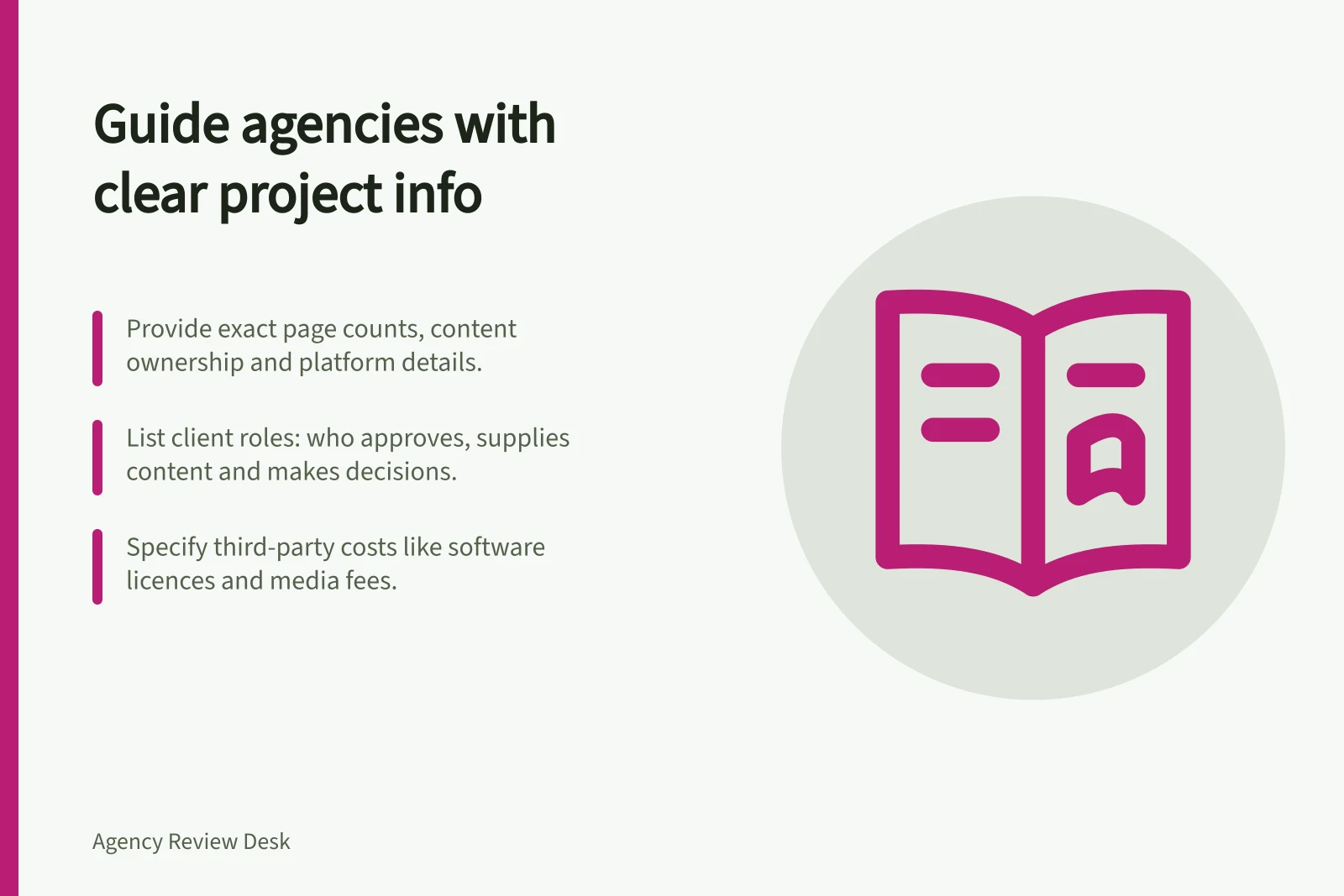
Start with the brief, then add details that can change the amount of work. For a website project, this may include page numbers and types, content ownership, existing platform, integrations, migration needs and approval steps. For recurring marketing, it may include markets, channels, current assets, expected production volume, reporting needs and who will implement recommended changes.
Use actual figures where available, with a date and definition. “About 40 pages need review” is more useful if it states whether those are distinct templates, translated variants or pages with new copy. If you have not counted them, state that the volume is unconfirmed and ask agencies how they would price that uncertainty.
Show what already exists
Provide a concise inventory of relevant assets, accounts, past research, brand guidance and technical documentation. Say what can be reused and what needs permission or further inspection. Summarise any known defects or constraints affecting the work. Do not send a large folder without explaining which items are current.
Access can be arranged after an initial conversation where necessary. If an agency must inspect a system before committing to a price, describe the inspection you can permit and when it can happen. Distinguish information you have shared from information an agency has yet to verify.
Make client work visible
Name who will supply facts, give feedback, approve claims, make technical changes and decide budget. State how many teams must review work and any known periods of unavailability. A design and copy quote may differ if your staff will write the source material or the agency must research and produce it.
List third-party costs that may sit outside the agency fee: media, software, licences or specialist production. Ask agencies to show these separately and state whether each amount is known, estimated or excluded. Ask for a written quote that clearly describes the work, itemised and total costs, applicable GST, timing and terms, so you can check what each response covers.
Ask for assumptions in a common response format
Request the same core fields from every candidate: included outputs, quantity or cadence, review allowance, timetable, client dependencies, exclusions, itemised fees, third-party costs and conditions that would change the price. Let candidates propose alternatives, but ask them to price the base request separately so you can see what differs.
Provide one contact and a deadline for clarification questions. If a question reveals a missing fact affecting every candidate, send the answer to all. Keep the dated brief and clarification record together.
Before requesting a final quote, check the largest unknowns. If the agency still cannot establish content volume, technical state or approval effort, agree what it will inspect first and what that inspection will deliver. A narrower, well-defined first stage can give the later price a firmer basis.